Monday, October 29, 2012

FTB13: N Lopez Bridge sucks 11.4.12

Lafitte Corridor once was a canal and railroad connecting the French Quarter and Bayou St John.  Right now, it is a mostly-vacant tract of land planned for redevelopment as parkland... whenever there is enough $$.  At its base along Claiborne, stretching away from the river, past the former Lafitte Projects, it is a partially-fenced green space (including active NORD public swimming pool) becoming an industrial zone once it crosses over Broad.  Along this stretch of the corridor (bounded by Conti and Lafitte Streets), the canal is open to the air above and one can find a fenced-off graveyard of street signs, a fence holding in the Red Bull skateboard ramps brought down on a barge last October*, and a deteriorated bridge along N Lopez St as it crosses the canal.

 You will most likely see a couple of folks walking across the bridge as they come from/go to Canal St or even a frustrated biker dismounting because of the poor bridge condition and Jersey barriers (common in military installations**) blocking the way.  Often folks will hang out here, falling through the deck or almost landing in the canal due to missing railings.

plan of the bridge... the blue is the pristine canal water.  "x"s are railing posts. big black bowling pin on fire is a huge pipe with a tree overhanging.

SO

We will be meeting up on Sunday, November 4th at 9:00, at the N Lopez Bridge.  The spot has a lot of potential, beyond just making it walkable/bikeable.  Things to bring, if you have them:
-wood, plastic, net, rope, tree branches, anything around 83" long (to replace railings)
-pieces of wood (2x12s + plywood is ideal, but we can work with anything) to fill in holes in the deck
-screws/nails >2 1/2"
-paint/brushes

lets see what happens...

*the Red Bull Skate Barge ramps sit on rented trailers in storage, while decisions are not made as to where they can go, only touchable by union workers, while New Orleans skaters are without a city-approved public park.  The much-hyped recent Lil Wayne/Mtn Dew park - NOT OPEN ANYMORE - had a handful of problems, such as $5 entry and only open 9-5. 
** these have been here at least 5 years now, although the rebar loops on their edges are meant for "short-term placement"

Monday, September 24, 2012

FTB10: outputting 10.3.12

So, there are a few examples of how redevelopment issues are being addressed around NO with the "PitchNOLA 2012" Lots of Progress and Idea Village "Water Challenge" initiatives going on around town.  These have ties to similar "public input" redevelopment projects such as 2012's "Love Your Block"  and 2011's Urban Innovation Challenge. What are the motives and people behind these initiatives, what the process is to make changes thru them, who guides these processes?  At the bottom of the PitchNOLA site there is a pdf by Jericho Road and Tulane City Center that describes potential plans for abandoned lots around town.

This Wednesday we will discuss these and other ways that participatory urban environment sculpting takes place.... how this is done outside of these formalized processes.  This will be merged with the Saturday "do stuff" meetup idea and start the process of building something, beginning the 2nd phase of class more focused around materials + methods of building. Relevant reading not online = stay up on the news/what your neighbors are yelling about/what you pass by every day but don't think about.


Sunday, September 16, 2012

FTB09: connecting the dots 9.19.12

OK, so the group has been going for a solid number of weeks.  I'm stoked that folks have had interest, and new faces keep coming.  For this week's class, lets reapproach past readings and notes (all linked in previous posts, duh), and draw lines between them.  The past weekend's events concerning the fight for housing in Haiti were inspiring, so we will also be touching on what was said by Reynelle Sanon, Bill Quigley, STAND With Dignity, Other Worlds, and Survivors' Village in comparing the struggles in Haiti and New Orleans. 

Remember back in the first meet-ups when we talked about the often-overlapping roles of CREATORS, CONTROLLERS, and USERS of the built environment?
And how we have looked at who is concerned with certain issues, and why? 
In retrospect, what did we miss during earlier discussions, now that we have delved deeper?
What questions do you now have about past subjects?
What has been highlighted and hammered home?
If you missed a class, maybe this is a chance to catch up on those readings and we can see the subject in a new light. Maybe you can pick the subjects that seemed most relevant to you and bring something new in to add... take it wherever you want, but lets take a step back and try to digest some of what we've chewed upon. 


Liberian land disputes (FTB06) --> dissected by Norwegian Refugee Council --> funded in part by StatOil (in areas of investment interest) [CONTROLLERS of how environment is perceived]--> NGOs as a tool for expansion of national interest / envelopment--> NGOs representing privatization of governmental services --> tenant purchase/Hope VI/Choice Neighborhoods and the path to privatization of public housing [transfer of CONTROL] --> New Orleans public housing struggle [USERS seeking CONTROL] --> STAND With Dignity + Section 3/local hiring [USERS becoming CREATORS]--> and so on...

Monday, September 10, 2012

FTB08: Haiti reconstruction 9.12.12


This Friday, Sept 14, come hear Reyneld Sanon (Haitian housing rights activist) and New Orleans lawyer/professor Bill Quigley speak on housing rights and reconstruction after Haiti's devastating 2010 earthquake:


We've been discussing much about types of displacement, their causes, and how they are addressed.  This week we will focus on Haiti's reconstruction, with a presentation by a friend who recently worked with Haitian organization ITECA (link goes to secondhand description) in Gressier (near Leogane, the epicenter of the quake).

note the lack of website for ITECA: it is important to note what we find in mass media with regard to who is conducting rebuilding efforts in Haiti, as many of  the efforts by Haitians maintain little-to-no web-presence, compounding the assumption that international organizations are saving the day as Haitians remain incapable.  This ties in to Haiti's history as a county with little self-determination, while much of the international community's efforts have been criticized as "photo-op philanthropy" with little on-the-ground results for Haitians and much money wasted on infrastructure and over-pay of international workers.


While around 500,000 Haitians remain internally displaced with little infrastructure, the Under Tents campaign (website down at time of posting) is fighting for a comprehensive housing plan, demanding
  1. an end to the forced eviction of Internally Displaced Persons' (IDP) camps
  2. designation of land for permanent housing
  3. a centralized government institution to coordinate and implement a social housing plan
  4. allocation of funding to carry out these goals
a few case studies in a sea of stories:
Haiti's rebuilding has many faces, as housing, public infrastructure, and private businesses all faced destruction in urban areas such as Port-au-Prince and Jacmel as well as in rural areas that have received much less media attention.  Haitian groups, individuals (local and international), NGOs of various sizes, and international governments have all played roles, with large-scale non-Haitian organizations such USAID and the UN maintaining powerful voices throughout. Haiti Grassroots Watch tells the story of Champs de Mars camp residents.

Some NGO's work as apolitical contractors to rebuild certain areas or structures: Architecture for Humanity is working in Villa Rosa, Port-Au-Prince as well as with several other projects, as part of a larger-scale approach to rebuild in a way aimed at sensitivity to local needs and realities.

Some projects are created by foreign groups for economic development:  Caracol industrial park, a US-backed development project that sadly seems to point towards exploitation of Haitian laborers for the benefit of international markets. 

from "Too Soon for Carnival: Sweeping Haiti's 400,000 Poor Back Under the Rug"

some relevant documents from past classes to check back over:
-see end of previous post re:President Martelly's 16/6 plan for relocating IDP camps

-"Confusions’ and Palava: The Logic of Land Encroachment in Lofa County" - describes the clash of customary use-valued land tenure systems and title-based market-valued land tenure systems in Liberia.  Land titling in Haiti has often been informal, and titling records were also lost in the earthquake in many cases.  Many people left in Internally Displaced Persons' camps are those who did not have formal title to the land they were living on.


cadastre: ca·das·tre also ca·das·ter (k -d s t r). n. A public record, survey, or map 
of the value, extent, and ownership of land as a basis of taxation.


Monday, August 27, 2012

FTB07: delayed 8.29.12

So, since the storm named Isaac is planning to visit town this Wednesday, let's say no class... we will resume on next Wed, Sept 5, covering the readings from last class (Liberia, etc... see last post) If missing class really gets your goat, join up at the New Orleans Community Print Shop's work day on Saturday at noon (each week, Thurs at 6 + Sat at noon). Its in a warehouse at 1201 Mazant.  They have done a rad job building out the space, and its a fun time with a killer crew of folks (plus they always have food + coldcold h20 +beer).


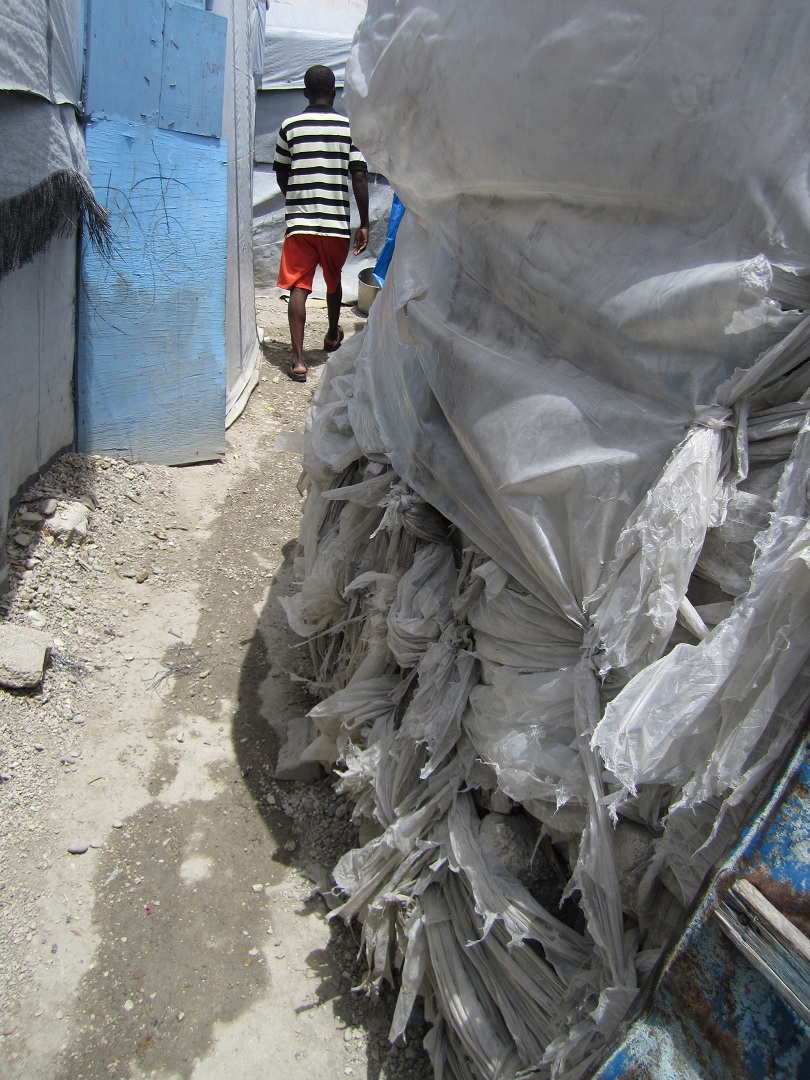
A new slum at Mourne L'Hopital, Haiti, comprised mainly of T-Shelters (temporary shelters) donated by NGOs.  Many Haitians are living without sufficient housing or infrastructure such as sewage or water. (photo from Haiti Grassroots Watch)

On the anniversary of Katrina, remember people who still haven't recovered from a disaster.  Folks still are displaced here in the US, unable to return to New Orleans for various reasons, much based around exclusionary changes to NOLA's built environment (rent increases, public housing demos, loss of housing, et al).  Isaac just swept through Haiti, where some report 500,000 people are still internally displaced.  President Martelly, along with Bill Clinton, recently put forward the 16/6 plan to close 6 internally displaced persons' camps and provide money for housing, for a small number of them.  Many criticize this as purely putting the problem of tent camps "out of site, out of mind."  The Institute for Justice and Democracy in Haiti recently surveyed many Haitians as to how well this 16/6 plan is working.

Monday, August 20, 2012

FTB06: 8.22.12

Liberian civil war broke out in the 90's.  This led to many people being displaced, problems with public infrastructure, and a mass migration towards urban areas, leading to "unplanned development" which is now, in some cases, being bulldozed to make way for "planned development." The Norwegian Refugee Council has been working to resolve land disputes in Liberia, which is broken down in the following reports (in chronological order):
 
"Confusions’ and Palava: The Logic of Land Encroachment in Lofa County"
“Comparative Analysis of Land Conflicts in Liberia: Grand Gedeh, Lofa and Nimba Counties"
"Searching for Soap Trees: Norwegian Refugee Council’s land dispute resolution process in Liberia
Beyond Squatters' Rights: Durable Solutions and Developmentinduced Displacement in Monrovia, Liberia


displaced, but to where?  how does this compare to Section 8 voucher use? (from T-P article on CJ Peete redevelopment)
 Iberville redevelopment's Choice Neighborhoods Initiative plan and design overview. The Iberville redevelopment is inextricably tied to the Canal Street Redevelopment, which seems to be purely tied to economic development.  According to Kelo v. the City of New London, economic development is considered in the public interest. 

"residents remember thriving local businesses" -HANO Choice Neighborhoods Initiative proposal

The above readings are pretty long.  Discussion from last class led to some topics to further explore, so if you'd rather, research these issues on your own!
  • Columbia University's expansion/other eminent domain situations + ensuing pushes for alternate plans
  • Eminent domain time/expediency/accountability requirements


Thursday, August 9, 2012

FTB05: redevelopment 8.15.12

Affordable Housing Institute is a group that works to increase affordable housing ecosystems worldwide by providing financial advice and other resources to small localized housing groups, policy makers, and other "pro-poor entities."   AHI tells the story of the Cape Town, South Africa's Joe Slovo township and its redevelopment after a 2009 fire destroyed 500 shacks and left 1500 people homeless (also see parts two, three, and four).

In a storyline relevant to our recent discussions of New Orleans' and St Louis' public housing approaches, AHI also recently posted a 4-part article on public housing post-Hurricane Ike in Galveston, Texas.   The Cape Town, Galveston, and New Orleans situations are all tied together in that they were all prefaced by large disasters.

Palace Hotel being imploded in New Orleans: eminent domain in
Lower Mid-City for greenspace within the LSU/VA hospital footprint

The 2005 supreme court case of Kelo v. City of New London comes up often as setting precedent for eminent domain used in redevelopment, urban renewal, or whatever you'd like to call it.  The Kelo case redefined "public purpose" for eminent domain as including economic development, based on precedents set by Berman v. Parker and Hawaii Housing Authority v. Midkiff.